

- Following the government’s update last week on AI Growth Zones, Kao Data yesterday hosted a senior team from the Department for Science, Innovation and Technology (DSIT) as well as civil servants from the AI Energy Council, Office for Investment, DESNZ, DBT and DEFRA.
- Alongside it’s customers and partners, including Arm, NVIDIA, Nscale and Ciena, Kao Data provided insight on the AI development lifecycle, highlighting the critical role of connectivity, CPU and GPU architectures and data centres in delivering UK AI acceleration plans.
- The AI field trip also gave the opportunity to explore the issues that threaten the success of AIGZs and the government’s longer-term AI ambitions such as power pricing, AI copyright law and uncertainty around eventual end-user AI offtake, and AIGZ development parameters.
London, United Kingdom, 8th May 2025 – Following news that the UK Government has invited local authorities and public-private stakeholders across the country to submit formal applications for AI Growth Zones (AIGZs), Kao Data, the specialist developer and operator of data centres engineered for AI, hosted a cohort of senior government officials for an AI field trip at its Harlow data centre campus in Essex, yesterday.
Together with its customers and partners including Arm, NVIDIA, Nscale and Ciena, Kao Data was joined by representatives from the Department for Science, Innovation and Technology (DSIT) the AI Energy Council, Office for Investment, Department for Energy Security and Net Zero (DESNZ), Department for Environment, Food & Rural Affairs (DEFRA) and No. 10.
During the event, speakers including Karl Havard, Chief Commercial Officer (CCO), Nscale, Andy Grant, EMEA Director, Supercomputing, Higher Education and AI, NVIDIA, David Lecomber, HPC GTM, Arm, Bhudutt Jangid, Director of Sales Engineering, Ciena and Spencer Lamb, CCO, Kao Data, shared key insights into the complex interplay between industrial-scale data centres, low-latency connectivity, and next-generation CPU and GPU technologies.
The group were given the opportunity to tour both KLON-01 and KLON-02 data centres, led by Kao Data’s Chief Technology Officer (CTO), Paul Finch and to view the early construction and development of KLON-03, Kao Data’s recently announced 17.6MW, liquid-cooled facility. The tour ended with an exclusive view of Arm’s high performance computing deployment within KLON-02 led by Arm’s CIO, Sarah Cunningham, and Dawn Johnson, Arm’s Data Centre Manager.
Following presentations, discussions covered the issues identified by the technology sector that threaten the success of AIGZs and the government’s longer-term AI ambitions, as outlined in it’s AI Opportunities Action Plan. Topics included UK energy pricing – currently x3 more expensive than the United States and other EU nations, AI copyright laws which threaten to reduce AI footprints in the UK, and how the government proposes AIGZs are funded. Without certainty on the eventual AI offtake from government, in addition to the AI copyright law uncertainty and high energy costs, investment in data centre infrastructure could be heavily restricted.
The initial topline parameters for AIGZs – 500MW across 100 acres by 2030 – were also discussed with government officials, with the technology sector suggesting a flexible, phased approach that would allow significant AI compute to commence this year, and allow it to ramp-up to 500MW across a geographic zone immediately supporting university, AI-start-up, enterprise and government utilisation.
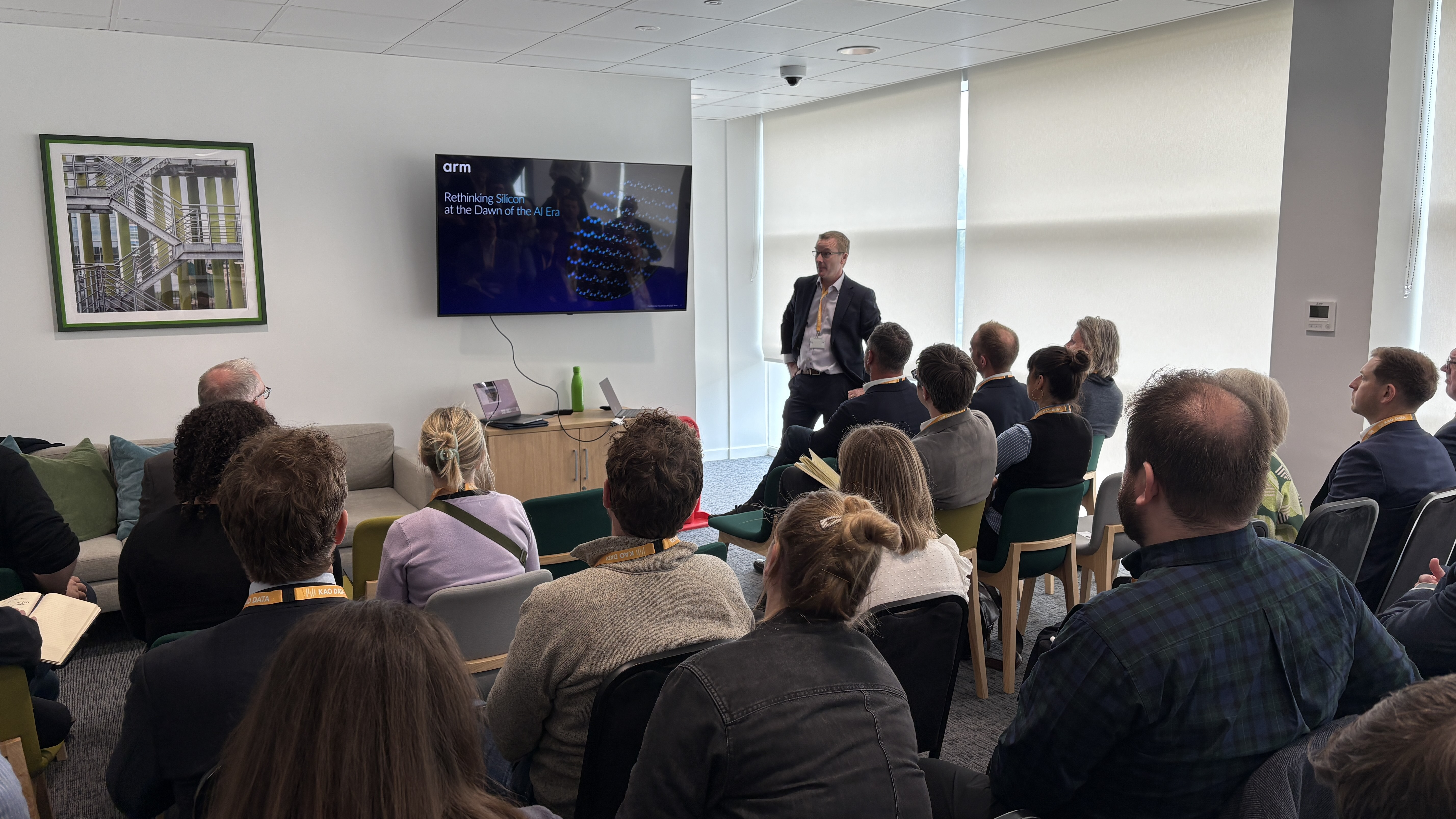
Above: David Lecomber, HPC GTM at Arm presented on Arm’s crucial role within the development of AI, following a tour of Arm’s deployment within Kao Data’s KLON-02 data centre.
“The UK continues to hold a leading position in the global AI race and we welcome and embrace the AIGZ initiative but without significant policy reform to key areas like energy policy, AI copyright and the intended AIGZ parameters, our country will never realise the true economic potential of the AI Opportunities Action Plan, or keep pace with our neighbours in the USA, France and Germany,” said Spencer Lamb, CCO, Kao Data. “This week’s AI field trip proactively brought together senior government officials with leading technology companies to showcase the critical role of infrastructure in delivering UK AI capabilities at-scale, and discussed the pragmatic steps needed to deliver AI Growth Zones inline with the government’s AI Opportunities Action Plan, and its Plan for Change.”
Karl Havard, CCO, Nscale, added, “As the UK pushes forward with its AI Growth Zones, it is crucial that we prioritise AI sovereignty to ensure long-term resilience and innovation within our borders. At Nscale, we are committed to providing secure, sovereign AI infrastructure that meets the demands of today’s applications and is adaptable for tomorrow’s breakthroughs. Our collaboration with Kao Data and other key partners exemplifies our shared vision for a scalable, sovereign AI ecosystem that can compete globally while safeguarding national interests and economic growth.”

Above: Karl Havard, CCO at Nscale presented on the importance of sovereign AI infrastructure and how Nscale will be investing £2 billion in the UK data centre industry.
Following the field trip, Kao Data will continue to work with NVIDIA and Nscale on the development of full AIGZ submissions in various UK regions, and is also looking forward to continuing its engagement with strategic partners in Manchester to profile the opportunities for a North West AIGZ within Greater Manchester.